Nader coined an interesting concept about Shaykhism (see post #3 )
In essence Shaykhism is Shi`ism with a Sufi twist.
Also, I have been noticing that Shayh Ahmad Ahsai position is not very clear. Or maybe we are not understanding his position.
Please click on the link for further info.
Friday, November 4, 2011


Thursday, November 3, 2011
Was Shaykh Ahsai an Akhbari or an Usooli?
post # 8 from SC topic (contribution by a user)
Shaykh wasn't akhbari. He was usooli and one of his teachers was Sayyid Mahdi Bahr al-'Ulum Tabataba'i from whom he received letters of ijtihad as well as Kashifu'l Ghita & others. He did have akhbari teachers since Bahrain was a major center of akhbari activities in the late 1700s and they didn't mind teaching him.Shaykh Ahmad Ahsai bio.
According to some reports by the time of his death in the 1820s, about a 25% of Iran's population gave him taqlid. During his heyday, he was one of about 7 marjas in Yazd and Kermanshah but his followers were considered to be unusually attached to him & his teachings. He was originally from eastern Arabia and taught in Bahrain and attended the hawzas of Najaf & Kerbala. He refused to acquiesce to other ulema on his views and he refused to be legitimized by the Fath 'Ali Shah, the Qajar king.
The major source of issue for some about him was that he was an arif and because of this sometimes the views of the arif contrast with those who are juristic in background. He viewed the Shi'ite jurisprudent as a mystic and one who should be overwhelmingly spiritual by nature. The concept, as totally expounded by Shaykh, is similar to the Sufi concept of a qutb. In simpler terms, another form of legitimacy for the jurisprudent was through the qalb (heart) via dreams and he based his views on various Qur'anic passages as well as from certain hadith.
He had takfir pronounced upon him by Mulla Muhammad Taqi Baraghani of Qazwin but none of the ulema of the first order such as Shaykh Musa, the son of Kashifu'l Ghita, Mulla Ali Nuri or Mulla Ahmad Naraqi to name a few would do such. Really, there's nothing much different (from my unknowledgeable eyes) that's different from the school of Isfahan. Had Shaykh lived 200 years earlier, he would have been included among them.
...Shaykh al-Ahsai did not have anything to do with the creation of the Shaykhi school of thought, although again, his views were considered controversial among Usoolis & Akhbaris alike. He had influence on them but Sayyid Kazim Rashti, one of al-Ahsai's disciples, was the actual founder and even he didn't see himself or the latent Shaykhi movement as something seperate from the Usooli school.
Shaykh al-Ahsai never saw himself outside of the mainstream flow of Shi'ite ideology. Some of Shaykh's writings are confusing when read but you would need a qualified spiritual instructor to get through some of his letters. The Bahais like to use him because of his writings on the Perfect Shiite or the Perfect Man (Insan-e-Kamal). There's a lot more. You can read an article on him from Juan Cole who has written extensively on him and there's another work I read on Shaykh but I can't remember the author's name right now but it was very profound because it dealt with the metaphysical aspects of Shaykh's views and it was the author's thesis. I'll know in two weeks because there's a brother I know who has the book and I'll see him next weekend.
Translating Arabic words to English
The Grammar Girl podcast has a new episode on why it is so difficult to translate Arabic words to English.
Translating Arabic words to English is difficult because the languages use different alphabets and there are no set rules to correlate the Arabic letters to the Latin letters we use in English. When we see Arabic words written in English, they’re actually not a translation, but a transliteration--a representation of how the Arabic words would sound if they were written in the Latin alphabet. Since sounds can be interpreted slightly different ways, you'll see "Gadaffi," "Kadafi," "Qaddafi," and so on.
It’s the same reason you see “Koran” spelled a few different ways in English publications including “Koran,” “Quran,” and “Qur’an.” There isn’t a right or wrong way; it’s a style choice.
Wednesday, November 2, 2011
So Many Books
Reading and Publishing in an Age of Abundance by Gabriel Zaid
A small book with a total of 142 pages.
This is a book review done in September of last year. It was originally posted here.

To the Unrepentant Reader,
The reading of books is growing arithmetically; the writing of books is growing exponentially.
If our passion for writing goes unchecked, in the near future there will be more people writing books than reading them!
This book is asking a question that nobody in their right mind would think to ask;
Is reading books really useful, healthy or even necessary?
If you say YES! Then you are absolutely wrong!
I am quoting selective passages from the book, so you can see what the author thinks
Page 22:
When we say that books should be read by everyone, we aren’t thinking. Our simple physical limitations make it impossible for us to read 99.9 percent of the books that are written.
Humankind writes more than it can read.
A small book with a total of 142 pages.
This is a book review done in September of last year. It was originally posted here.
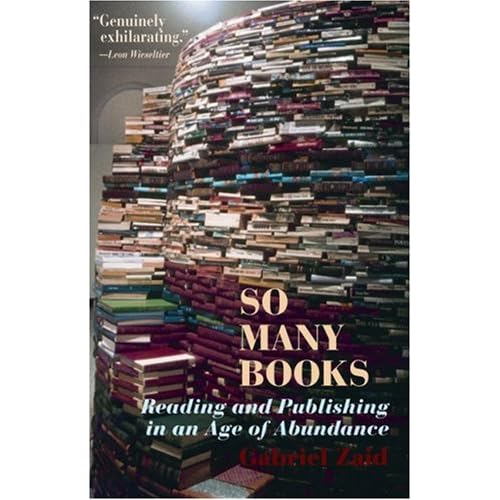
To the Unrepentant Reader,
The reading of books is growing arithmetically; the writing of books is growing exponentially.
If our passion for writing goes unchecked, in the near future there will be more people writing books than reading them!
This book is asking a question that nobody in their right mind would think to ask;
Is reading books really useful, healthy or even necessary?
If you say YES! Then you are absolutely wrong!
I am quoting selective passages from the book, so you can see what the author thinks
Page 22:
Books are published at such a rapid rate that they make us exponentially more ignorant. If a person read a book a day, he would be neglecting to read four thousand others, published the same day. In other words, the books he didn’t read would pile up four thousand times faster than the books he did read, and his ignorance would grow four thousand times faster than his knowledge.Page 24:
A Universal Library system is established (a great library of Babel) that holds every single book ever published, more than fifty million titles;…each reader is able to read four books a week, two hundred a year, ten thousand in a half-century. It would be as nothing. If not a single book were published from this moment on, it would still take 250,000 years for us to acquaint ourselves with those books already written.
When we say that books should be read by everyone, we aren’t thinking. Our simple physical limitations make it impossible for us to read 99.9 percent of the books that are written.
Humankind writes more than it can read.
Tuesday, November 1, 2011
Differences between 12-Imam Shi'ism and Zaydis or Ismailism
Straight from this book
Imamis (The Twelver)
The Shi'ites asserted that the Islamic caliphate, of which esoteric guidance and spiritual leadership are inseparable elements, belongs to Ali and his descendants. They also believed that according to the specification of the Prophet the Imams of the Household of the Prophet are twelve in number. Shi'ism held, moreover, that the external teachings of the Quran, which are the injunctions and regulations of the Shari'ah and include the principles of a complete spiritual life, are valid and applicable for everyone at all times, and are not to be abrogated until the Day of
Judgment. These injunctions and regulations must be learned through the guidance of the Household of the Prophet.
Imamis vs. Zaydis
From a consideration of these points it becomes clear that the difference between Twelve-Imam Shi'ism and Zaydism is that the Zaydis usually do not consider the imamate to belong solely to
the Household of the Prophet and do not limit the number of Imams to twelve. Also they do not follow the jurisprudence of the Household of the Prophet as do the Twelve-Imam Shi'ites.
Imamis vs. Ismailis
The difference between the Twelve-Imam Shi'ism and Isma'ilism lies in that for the latter the imamate revolves around the number seven and prophecy does not terminate with the Holy Prophet Muhammad. Also for them, change and transformation in the injunctions of the Shari'ah are admissible, as is even rejection of the duty of following Shari'ah, especially among the Batinis. In contrast, the Twelve-Imam Shi'ites consider the Prophet to be the "seal of prophecy" and believe him to have twelve successors and executors of his will. They hold the external aspect of the Shari'ah to be valid and impossible to abrogate. They affirm that the Quran has both an exoteric and an esoteric aspect.
Reference
Shia by Allamah Sayyed Muhammad Husayn Tabatabai
Imamis (The Twelver)
The Shi'ites asserted that the Islamic caliphate, of which esoteric guidance and spiritual leadership are inseparable elements, belongs to Ali and his descendants. They also believed that according to the specification of the Prophet the Imams of the Household of the Prophet are twelve in number. Shi'ism held, moreover, that the external teachings of the Quran, which are the injunctions and regulations of the Shari'ah and include the principles of a complete spiritual life, are valid and applicable for everyone at all times, and are not to be abrogated until the Day of
Judgment. These injunctions and regulations must be learned through the guidance of the Household of the Prophet.
Imamis vs. Zaydis
From a consideration of these points it becomes clear that the difference between Twelve-Imam Shi'ism and Zaydism is that the Zaydis usually do not consider the imamate to belong solely to
the Household of the Prophet and do not limit the number of Imams to twelve. Also they do not follow the jurisprudence of the Household of the Prophet as do the Twelve-Imam Shi'ites.
Imamis vs. Ismailis
The difference between the Twelve-Imam Shi'ism and Isma'ilism lies in that for the latter the imamate revolves around the number seven and prophecy does not terminate with the Holy Prophet Muhammad. Also for them, change and transformation in the injunctions of the Shari'ah are admissible, as is even rejection of the duty of following Shari'ah, especially among the Batinis. In contrast, the Twelve-Imam Shi'ites consider the Prophet to be the "seal of prophecy" and believe him to have twelve successors and executors of his will. They hold the external aspect of the Shari'ah to be valid and impossible to abrogate. They affirm that the Quran has both an exoteric and an esoteric aspect.
Reference
Shia by Allamah Sayyed Muhammad Husayn Tabatabai
Subscribe to:
Posts (Atom)